
Master the Art of Light Travel with These Carry On Packing Hacks
Why Carry On Packing Hacks Can Transform the Way You Travel
Carry on packing hacks can save you real money, time, and stress every time you fly. U.S. airlines collect over $7 billion in checked baggage fees each year — and most of that is avoidable.
Here are the most effective carry on packing hacks to know before your next trip:
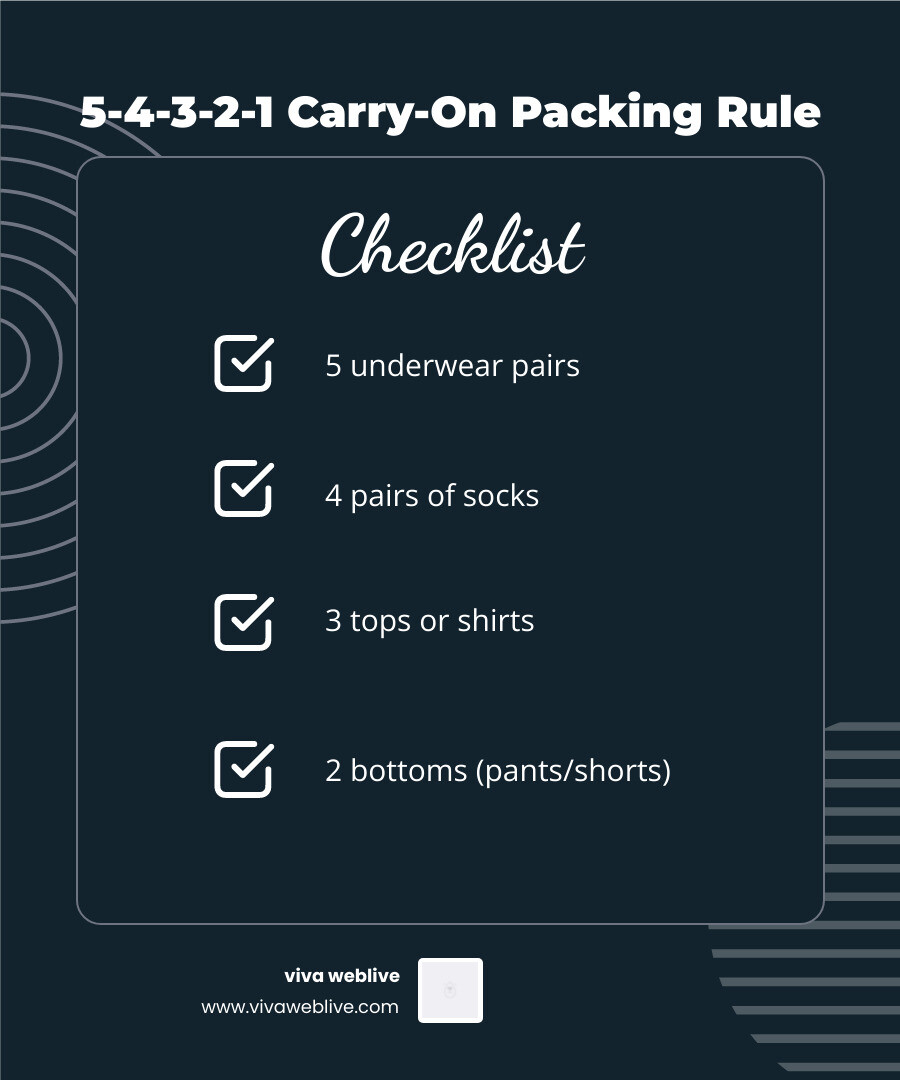
- Use the 5-4-3-2-1 rule — pack 5 underwear, 4 socks, 3 tops, 2 bottoms, and 1 outer layer
- Use compression packing cubes — they reduce clothing volume by 30–50%
- Roll clothes tightly (Ranger Roll method) — saves up to 30% more space than folding
- Stick to 2–3 pairs of shoes — wear the bulkiest pair on travel day
- Follow TSA’s 3-1-1 rule — liquids must be 3.4 oz or less, in one quart-sized bag
- Pack solid toiletries (shampoo bars, toothpaste tabs) — bypass liquid limits entirely
- Choose a bag under 22×14×9 inches — fits overhead bins on most U.S. carriers
- Put toiletries in your personal item — frees up carry-on space for clothes
Walking off a plane while everyone else waits 30 minutes at baggage claim is one of the best feelings in travel. It’s not luck — it’s a system.
The good news? You don’t need to be a minimalist to pull it off. You just need the right techniques. Whether you’re packing for a long weekend or a two-week adventure across multiple countries, these hacks will help you do it all with one bag.
The Foundation: Choosing the Right Bag and Packing Cubes
Before we even touch a single t-shirt, we have to talk about the “vessel.” In 2026, travel has become more efficient than ever, but airline restrictions are tighter too. Choosing the right bag is the first of many carry on packing hacks that will determine your success. We recommend starting with a bag that is inherently lightweight. Traditional suitcases can weigh between five and ten pounds when empty! That is a massive chunk of your weight allowance gone before you’ve even packed a sock.
For most of us, the “sweet spot” is a bag with a 35L to 45L capacity. If you go larger, you risk being forced to gate-check. If you go smaller, you’re entering the realm of “ultralight” travel, which is great but requires a very disciplined wardrobe.
Maximizing Space with Compression Packing Cubes
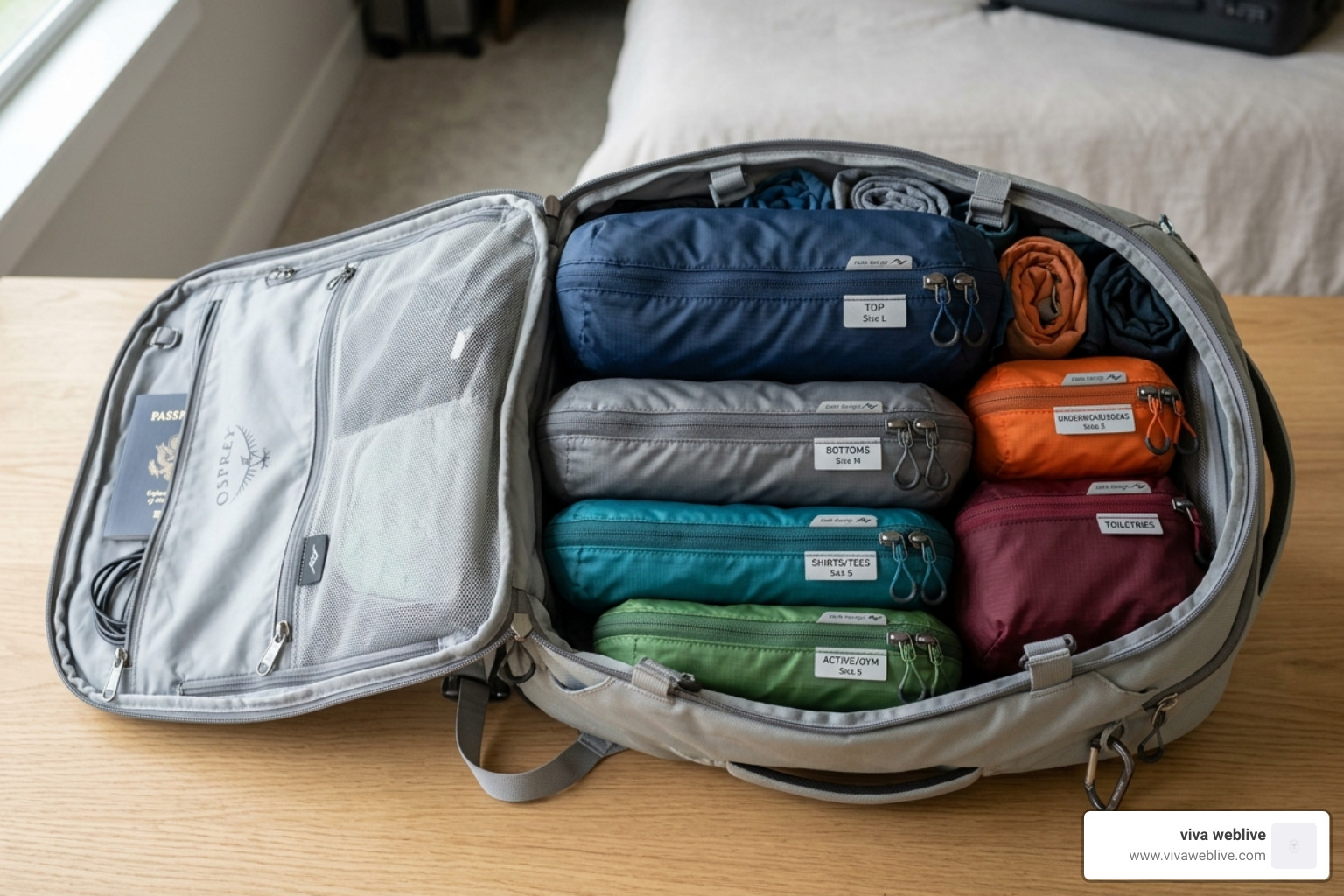
If you aren’t using packing cubes yet, welcome to the future. We often tell our readers that packing cubes are the “guardrails” of a light suitcase. They don’t just organize your gear; they physically limit how much you can bring. If it doesn’t fit in the cube, it doesn’t fit in the bag.
Compression packing cubes are the gold standard for carry on packing hacks. Unlike regular cubes, these have a secondary zipper designed to squeeze out excess air. This can reduce the volume of your clothes by 30% to 50%.
How to use them like a pro:
- Categorize: Use one cube for tops, one for bottoms, and a small one for “smalls” (underwear and socks).
- The Tetris Method: Arrange your cubes in your bag like a puzzle. Place the heaviest, largest cubes at the bottom (near the wheels or the base of the backpack) to keep the center of gravity low.
- Air Extraction: After filling the cube, zip the main zipper, then use your body weight to press down while zipping the compression zipper.
Lightweight Luggage and Backpacks for 2026
When selecting your bag for 2026 travel, look for a “clamshell” opening. This means the bag opens like a suitcase rather than a top-loading camping pack. It allows you to see everything at once and access your packing cubes without digging.
Hardshell suitcases are excellent for protecting fragile items and keeping your contents from being crushed, but they lack the flexibility of a soft-sided backpack. If you’re heading to a destination with cobblestone streets or many stairs—think Rome or Santorini—a 40L travel backpack is your best friend. Look for models under 6 lbs to ensure you stay within airline weight limits, which are often strictly enforced at 10kg (22 lbs) for international carriers.
For more expert advice on selecting the perfect gear, check out our more info about travel gear and essentials.
Expert Folding and Rolling Carry On Packing Hacks
Once you have your bag and cubes, it’s time to tackle the clothes. There is a long-standing debate in the travel community: to roll or to fold? After years of testing, we can confidently say that rolling—specifically the “Ranger Roll”—is the superior method for maximizing space.
The Ranger Roll vs. Vertical Folding
The Ranger Roll turns your clothes into tight, secure cylinders that won’t unspool in your bag. This method saves approximately 15% to 25% more volume than traditional flat folding.
How to Ranger Roll a T-shirt:
- Lay the shirt flat.
- Fold the bottom 2-3 inches of the shirt inside out to create a “cuff.”
- Fold the sides into the center so you have a long rectangle.
- Starting from the collar, roll the shirt as tightly as possible toward the bottom.
- Once you reach the end, tuck the entire roll into the cuff you created in step two.
If you prefer a more “visual” organization, vertical folding (often called the KonMari method) is a great alternative. This involves folding clothes into small rectangles and “filing” them vertically in your packing cube like books on a shelf. This allows you to see every item without digging to the bottom.
Managing Wrinkles and Dirty Laundry
One of the biggest fears of carry-on travel is looking like you slept in your clothes. To prevent wrinkles, use the “bundle wrapping” technique for formal wear. This involves wrapping your dress shirts or slacks around a central “core” of soft items (like socks or t-shirts). The tension prevents hard creases from forming.
For everything else, a portable travel steamer is a lifesaver. However, if you’re truly tight on space, the “shower steam” trick still works in 2026: hang your clothes in the bathroom while you take a hot shower.
Don’t forget the “dirty” side of travel. We always pack a dedicated waterproof laundry bag or an extra compression cube specifically for dirty clothes. This keeps your clean items smelling fresh and makes unpacking a breeze when you return home. Interestingly, scientific research on how fabric compression affects textile longevity suggests that while tight packing is great for travel, you should unpack and hang your clothes as soon as you reach your destination to maintain the fabric’s integrity.
Streamlining Your Wardrobe and Footwear
The secret to a successful carry-on-only trip isn’t just how you pack, but what you pack. We are huge advocates of the “Capsule Wardrobe.” This means every single item you pack should coordinate with every other item. Stick to a neutral color palette—think navy, grey, black, and white—with one or two “pop” colors.
The 5-4-3-2-1 Rule for Outfits
If you struggle with the “what if” trap (as in, “What if I need a ballgown in the middle of a hiking trip?”), the 5-4-3-2-1 rule is your best defense. For a week-long trip, pack:
- 5 sets of underwear and socks
- 4 tops (mix of t-shirts and one “nice” shirt)
- 3 bottoms (jeans, shorts, or a skirt)
- 2 pairs of shoes (one worn, one packed)
- 1 hat or accessory (like a pashmina)
This formula provides enough variety for over ten unique outfits. If your trip is longer than a week, don’t pack more clothes—simply plan a laundry session mid-trip. Most modern hotels and Airbnbs offer laundry services, or you can use a “sink wash” kit for quick-dry items like merino wool.
Efficient Shoe Packing Hacks for Carry Ons
Shoes are the ultimate enemy of the carry-on traveler. They are bulky, dirty, and inflexible. To win the war on shoe space, follow the 3-shoe limit: wear your bulkiest pair (like sneakers or boots) on the plane, and pack one pair of versatile flats or sandals. If you absolutely must have a third pair, make them very slim, like flip-flops or emergency dress shoes.
Pro Shoe Hacks:
- Shower Caps: Wrap the soles of your shoes in hotel shower caps to keep dirt away from your clean clothes.
- Dead Space: Never leave the inside of your shoes empty. Stuff them with socks, chargers, or belts.
- Perimeter Packing: Place your shoes along the edges of your suitcase to create a “buffer” for your clothes.

Tech and Toiletries: TSA-Friendly Organization
In 2026, electronics and toiletries are often the heaviest parts of our bags. Streamlining these categories is essential for keeping your bag under the weight limit and breezing through security.
Mastering the TSA 3-1-1 Rule with Solid Toiletries
The TSA 3-1-1 Liquids Rule (3.4 oz containers, 1 quart-sized bag, 1 person) is still the standard. To bypass this entirely, we recommend switching to “solids.”
- Shampoo and Conditioner Bars: These look like bars of soap and don’t count as liquids.
- Toothpaste Tabs: Small tablets that you chew and then brush with.
- Solid Cologne/Perfume: These come in small tins and won’t leak in your bag.
If you must bring liquids, decant them into high-quality silicone bottles. Avoid the cheap ones; they tend to leak under cabin pressure. A great carry on packing hack is to squeeze a little bit of air out of the bottle before sealing it to create a vacuum effect, which helps prevent leaks.
Electronics and Cable Management Without the Bulk
Gone are the days of carrying a different charger for every device. In 2026, the “Single-Cable Principle” is king. Invest in a high-wattage USB-C charger that can power your laptop, phone, and headphones. Pair this with a universal travel adapter that works in multiple countries.
To keep your cords from turning into a tangled mess, use a slim cable organizer or even a simple sunglasses case. And for the bookworms: we know there is nothing like the feel of a physical book, but a Kindle or tablet is the smartest way to carry a library without the weight.
Frequently Asked Questions about Carry On Packing Hacks
How do I pack for a 2-week trip in a carry-on?
Packing for two weeks is exactly the same as packing for one week—you just have to commit to doing laundry. Use the 14-night formula: 7 tops, 3 bottoms, and a mid-trip laundry day. Rely heavily on compression cubes and merino wool fabrics, which resist odors and can be worn multiple times before washing.
What are the most common packing mistakes to avoid?
The #1 mistake is packing “just in case” items. If you haven’t worn it in the last six months at home, you won’t wear it on vacation. Another mistake is packing heavy denim; jeans are bulky and take forever to dry. Opt for lightweight “travel pants” or technical fabrics instead. Finally, never ignore the weight limits of your specific airline. Even if your bag fits the dimensions, an overweight bag will get checked.
Can I fit winter gear in a carry-on?
Yes! The key to winter travel is “Wear, don’t pack.” Wear your heaviest coat, boots, and sweater on the plane. For the items you must pack, use vacuum-seal bags to flatten bulky sweaters. Focus on thin, high-performance layers like thermal base layers and packable down puffers that can fold into a tiny pouch.
Conclusion
Mastering carry on packing hacks isn’t about deprivation; it’s about liberation. When you travel light, you move faster, save money, and eliminate the anxiety of lost luggage. At Viva WebLive, we want to help you travel smart, gear up, and explore more of the world with less baggage.
By implementing the 5-4-3-2-1 rule, mastering the Ranger Roll, and embracing solid toiletries, you can easily fit everything you need for a multi-week adventure into a single overhead bin.
Packing Method Comparison Table
| Method | Space Saved | Best For |
|---|---|---|
| Traditional Folding | 0% | Home storage |
| Rolling | 15–25% | T-shirts, casual wear |
| Ranger Rolling | 25–30% | Maximizing every inch |
| Compression Cubes | 30–50% | Bulky items, organization |
| Bundle Wrapping | Variable | Preventing wrinkles in formal wear |
Ready to start your next adventure? Explore more travel tips at Viva WebLive and join the ranks of pro travelers who never wait at the baggage carousel again. Happy travels!
